


Share knowledge
PROPER NUTRITION FOR KINDERGARTEN CHILDREN, KINDERGARTEN

Apr
Preschool children, Preschoolers have extremely impressive physical development, tri no, language, vận động, thói quen ăn uống… Ở tuổi này trẻ bắt đầu thể hiện sự độc lập, eager to learn and explore the world, Behaviors that "imitate" adults appear - especially in matters of eating; thus build adequate healthy eating habits Nutrition for preschool children, Kindergarten will be a solid foundation for balanced development, comprehensive physical and mental health of children in the future.
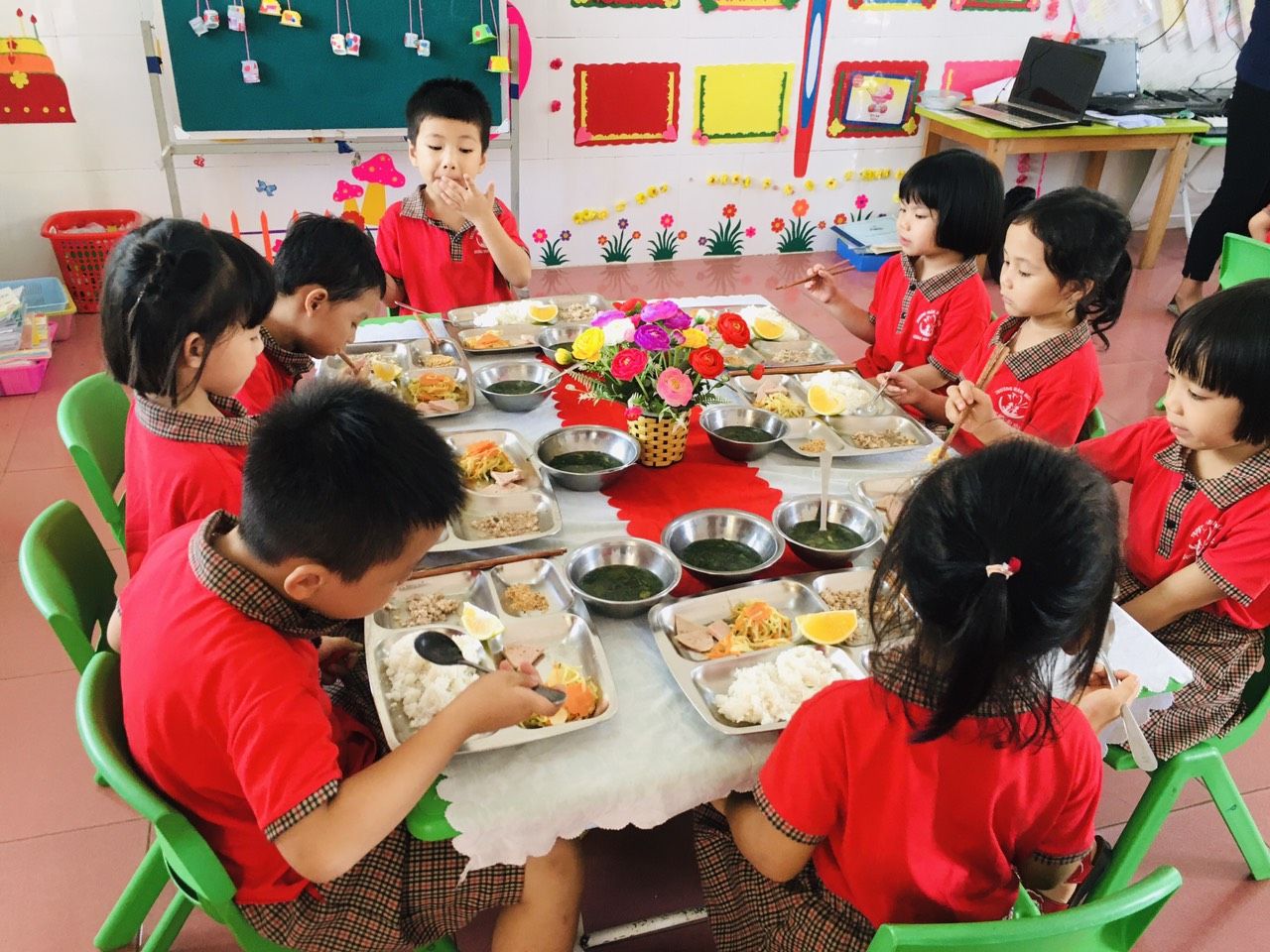
Nutrition for preschool children
Developmental characteristics of preschool children, preschool
Children of preschool age, The preschool seems to be constantly moving. They are busy moving all the time, everywhere, both indoors and outdoors. Children spend a lot of time running and jumping, Climb and chase each other; Enjoy the scribbles, Practice skillful hand movements through cutting activities with scissors, coloring practice, Simple cube assembly, play lego, string beads…
Children's motor skills have also been significantly refined since then; The child's fingers can move freely, Improved hand-eye coordination compared to toddlers, Movements are more agile and complete. Children at this age already know how to act purposefully, such as being able to arrange objects according to shape, sorted by color, Can practice physical exercises, Focus on listening to a story in a circle 2-5 minute, talk clearly, listen and sing along to a song and start asking “Why?”.
Children at this age show speed, strength and dexterity. Special, Children become increasingly independent, decisive, more confident, like "young grandparents" who surprise and delight their parents every day.
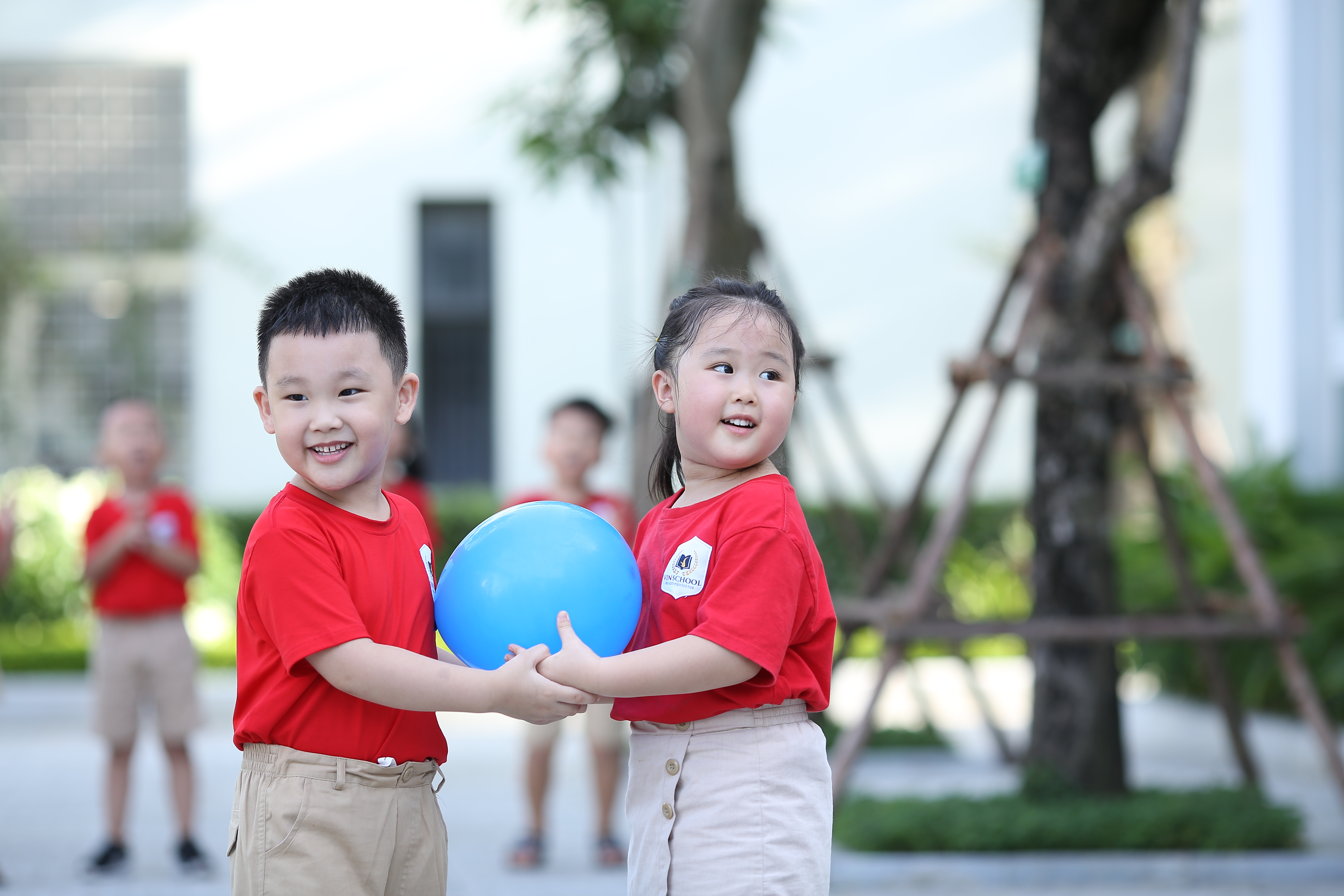
Children of preschool age do not like to sit still but like to move, Run and jump to explore around
Weight growth, height (physical, appearance)
During the preschool years, The child's height and weight increase steadily. Each month the child's weight increases by 100-150g, arrive 5 age normal weight from 18-20 kg. Compared to toddlers, Preschoolers are taller and slimmer. Body fat percentage is lowest compared to other ages, so you look slimmer. Height per month ranges from 1-1.5cm, arrive 5 Young people are about 110cm tall.
When the body of a preschooler, Preschool develops over time, Areas in the brain that control movement continue to mature, Allows children to practice and perfect gross motor skills such as running, dance, throw, climb, stone, dance, and fine motor skills like stringing beads, Draw and cut with scissors. Trẻ từ 5 From age onwards, one can move the whole body or do movements such as playing shuttlecock, climb.
Phát triển trí não
Intellectual development of preschool children, Preschool takes place through diverse activities: communicate, fun activities (at preschool age), work with objects (at preschool age) and the ability to enrich one's own life, Develop children's senses through daily activities such as listening, look, smell, taste, touch, hold…
Movement ability is becoming more and more perfect and refined, Many new motor skills at this age are the result of physical and mental growth and development. Children's language development at this stage is also closely related to the development of visual and action thinking, attention, children's memory.
Digestive system
Preschool children, Preschoolers have grown all their molars and children are also starting to gradually change their teeth. The child's digestive system is now complete, but avoid certain foods that damage the stomach such as spicy foods or foods that are too hot..
Be knowledgeable about the milestones of children's brain development, promptly supplement nutrition for preschool children, Kindergarten meets the needs of energy and necessary nutrients, which is the "matching combination" factor for children to develop comprehensively both physically and intellectually., healthy, thông minh hơn.
"Standard" weight for preschool children, kindergarten
At preschool age, A baby's height and weight gain varies between genders and from year to year. Below is a standard height and weight table for children 3 – 5 year old (according to the standards of the World Health Organization - WHO).
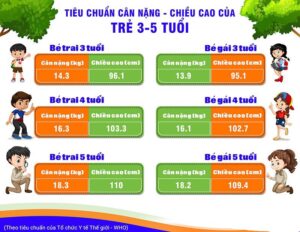
In case the baby is underweight, being overweight or not reaching standard height, Most likely because the baby has nutritional problems (like anorexia, lack of substance, béo phì, slow increase in height...). To accurately assess the nutritional status of children, Mothers should take their babies to reputable nutrition centers for examination, Advise and perform appropriate diagnostic tests.
The role of nutrition for preschool children, preschool
If the word 1 – 3 year old, Children begin to be curious about everything around them 3 – 5 year old, Children already know how to explore things on their own, Constantly asking questions of adults. This is also the period when children begin to learn about eating culture, dishes, amount of food per day... and from there form your own eating habits later.
Do đó, If parents do not properly develop a menu for preschoolers, Children may encounter nutritional problems at this age such as::
- Malnutrition: is a lack of energy, Lack of protein and important micronutrients, affects the physical and mental development of children.
- Overweight, béo phì: because the energy supplied is more than the energy consumed, causing the rate of fat stored in the body to exceed normal levels.
- Anorexia: Can originate from many causes such as pathology, Monotonous food makes your baby feel bored, Due to the influence of medication or psychological factors - the baby is uncomfortable when eating, The baby is afraid to eat because he is forced to eat...
Slow gain in height: Children do not reach height growth milestones for each age, makes children shorter than their peers.
Energy needs of preschool children, preschool
For preschool children, kindergarten (3 – 5 year old), Average recommended energy needs from 1.230 – 1.320 kcal/day. Trong đó, Carbohydrates account for 52 – 60%, protein accounts for 13 – 20%, fat takes up 25 – 35% total dietary energy.
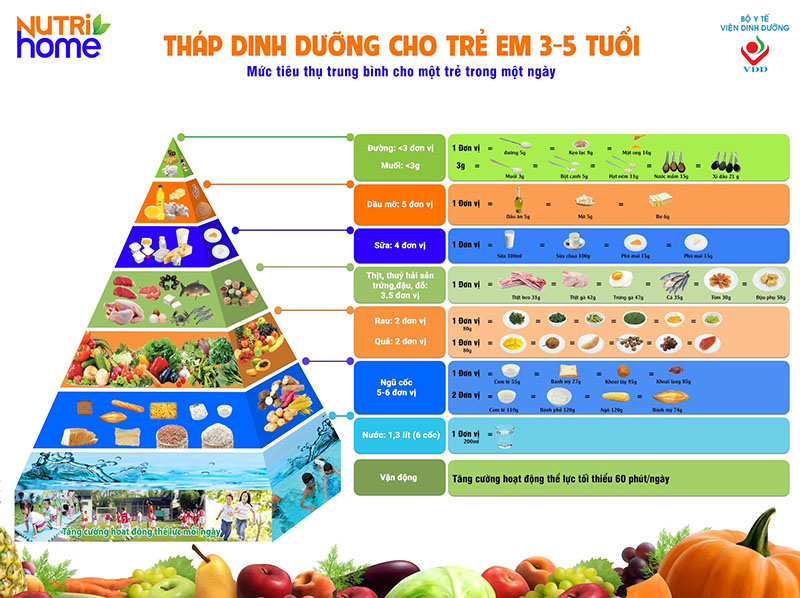
Nutritional pyramid for preschool children, Preschool is recommended by WHO and the Ministry of Health.
Theo đó, in the daily menu for preschool children, preschool, The amount of food that needs to be provided specifically includes::
- Carbohydrates: khoảng 3 – 4 bowl of rice, condensed porridge or similar dishes.
- Protein (meat, fish, trứng, shrimp, wind...): 120g – 150g.
- Fat (grease, butter…): 30g.
- Rau củ, fruit: 300g.
- Các loại vitamin và khoáng chất: vitamin A 1.000 UI, vitamin D 400IU, calcium 500mg, iron 6 – 7mg, Zinc 10mg…
To provide enough calcium for the body, Children need to be provided for 4 milk units/day (1 Milk unit equivalent to 100ml of liquid milk, 100g yogurt or 15g cheese).
Besides, Children also need to drink enough water (khoảng 1.6 – 2 liter/day).
Besides, Parents should also encourage their children to participate in appropriate sports activities to help them develop height and weight in the best way.. As recommended by the World Health Organization (WHO), Preschool age children need moderate or higher intensity physical activity with sports such as swimming, walk, run, playing tag… at least 60 minutes/day. Parents can divide activities into different time periods, every time at least 10 minute.
Some other notes when supplementing nutrition for preschool children, kindergarten
Besides calculation, Build a menu that provides enough energy for preschool children's needs, kindergarten, Parents also need to supplement their children with essential micronutrients such as vitamin A, C, D, group B, iron... Because if there is a lack of these micronutrients, Children may experience some symptoms such as::
- Vitamin A deficiency (abundant in carrots, papaya, broccoli, tomato, pumpkin…): Children are susceptible to dry eyes, dry skin, afraid of light, grow slowly, often cough, have a runny nose…
- Vitamin D deficiency (found in milk and dairy products, trứng, cá hồi, butter…): Children have slow growth in height, Startled while sleeping, hiccups…
- Vitamin C deficiency (Found in fruits such as oranges, guava, strawberry, grape, kiwi…): Children have dry skin, nose bleeds easily, bleeding gums…
- Vitamin B deficiency (like B1, B2, Biotin in cereals, nuts…): Children often have anorexia, prone to edema, mucosal margin inflammation, often cry, digestive disorders..
- Iron deficiency (present in the liver, tofu, Spinach, seafood…): Anemia (green skin, pale mucosa, pale nails…), Children often cry, difficulty sleeping, lack of concentration…
Do đó, Parents need to prioritize adding the above micronutrients to their children's daily meals. Trong trường hợp trẻ biếng ăn hoặc khó hấp thu, có thể cho bé dùng thêm các thực phẩm bổ sung. However, việc cho bé uống vi chất với liều lượng như thế nào, trong thời gian bao lâu cần được sự tham vấn của bác sĩ dinh dưỡng.
Articles on the same topic:
-
The quiet beauty of space: Infinite Discovery Journey
-

Discover the power of nutrition in healing
-

Discover the attractiveness of traditional vegetarian meals
-

Discover the power of meditation in modern life
-

Discover unexpected benefits from reading habits every day
-

Discover the mission of popularizing AI agents for business households in Vietnam
-

Application of artificial intelligence technology in business
-
Post articles about AI technology in business
-
Post an article by topic: The technology is managed by the year 2025
-

Post by topic: Vegetarian is really nutritious
-
An is more happy to serve 1000 Buddhist Buddhists
-
Benefits of science vegetarianism
-
Share the seed rolls of An Vegetarian with Tempeh Dau Lang
-

Vegetarian but still lacking quality?
-
Article on the popular topic of mother and baby
-

Bun bean chao chao vegetarian


